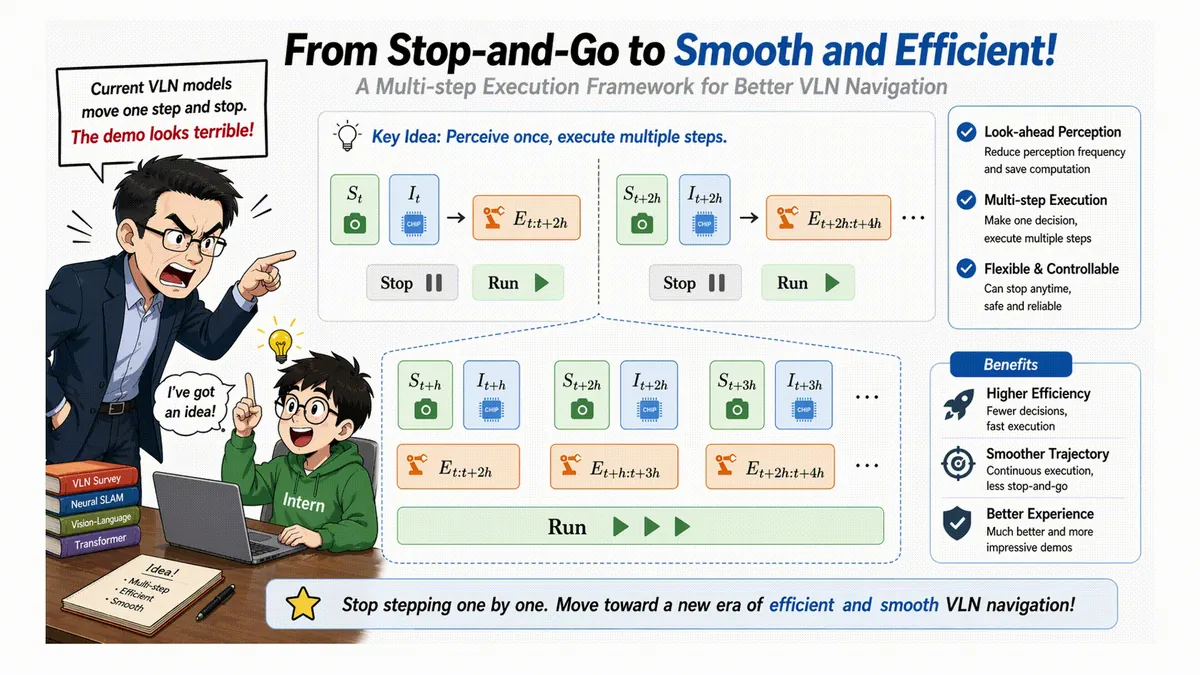
Overview
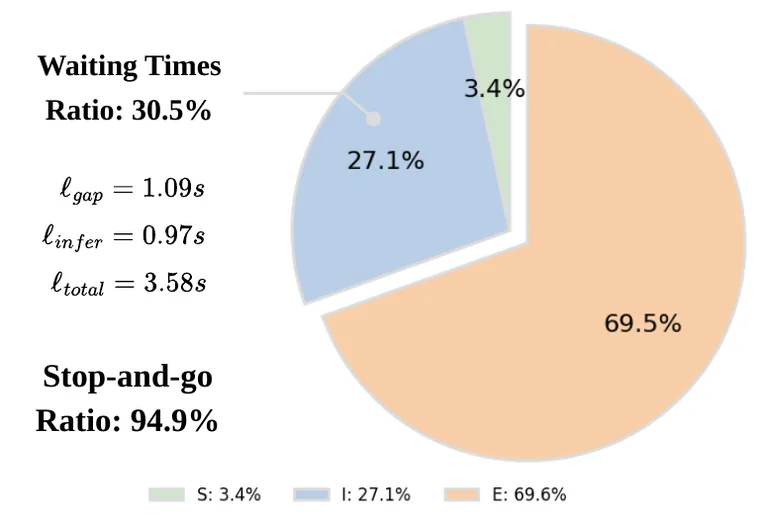
Strong vision-language navigation systems can still appear stop-and-go in real deployment because the robot often waits for sensing, transmission, and inference before continuing motion. LiveVLN targets this runtime bottleneck rather than only reducing model computation.
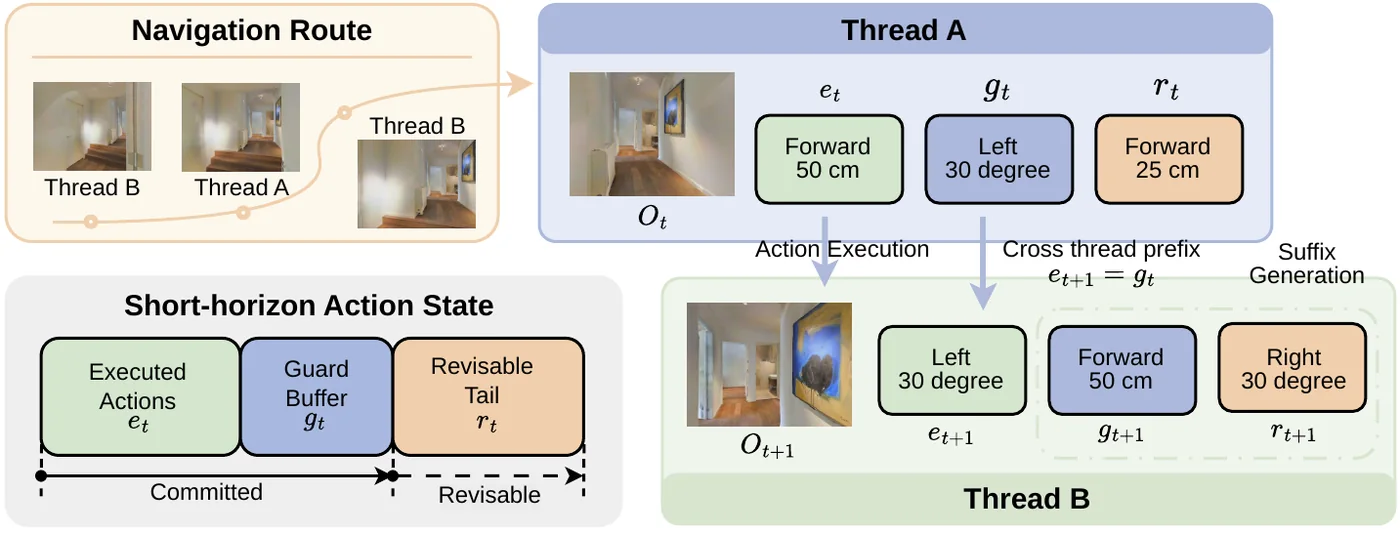
LiveVLN is a training-free runtime framework for compatible pretrained VLM navigators. It overlaps action execution with background observation refresh so that the next continuation can be handed off before the currently committed action prefix is exhausted.
Key Ideas
- Guarded handoff keeps a committed buffer available for continuous execution.
- A revisable tail leaves future actions editable under new observations.
- Real-time adaptation adjusts the guard budget according to recent sense-inference latency.
- Training-free integration wraps compatible pretrained checkpoints without retraining the backbone.
Results
Across R2R, RxR, and real-robot streaming settings, LiveVLN preserves benchmark performance while improving continuity:
- StreamVLN: waiting time reduced from 7.32s to 1.63s, and wall-clock episode time reduced from 41.98s to 36.71s.
- NaVIDA: waiting time reduced from 10.64s to 2.89s, and wall-clock episode time reduced from 34.90s to 28.06s.
BibTeX
@misc{wang2026livevln,
  title={LiveVLN: Breaking the Stop-and-Go Loop in Vision-Language Navigation},
  author={Xiangchen Wang and Weiye Zhu and Teng Wang and TianTian Geng and Zekai Zhang and Zhiyuan Qi and Jinyu Yang and Feng Zheng},
  year={2026},
  eprint={2604.19536},
  archivePrefix={arXiv},
  primaryClass={cs.RO}
}