Overview
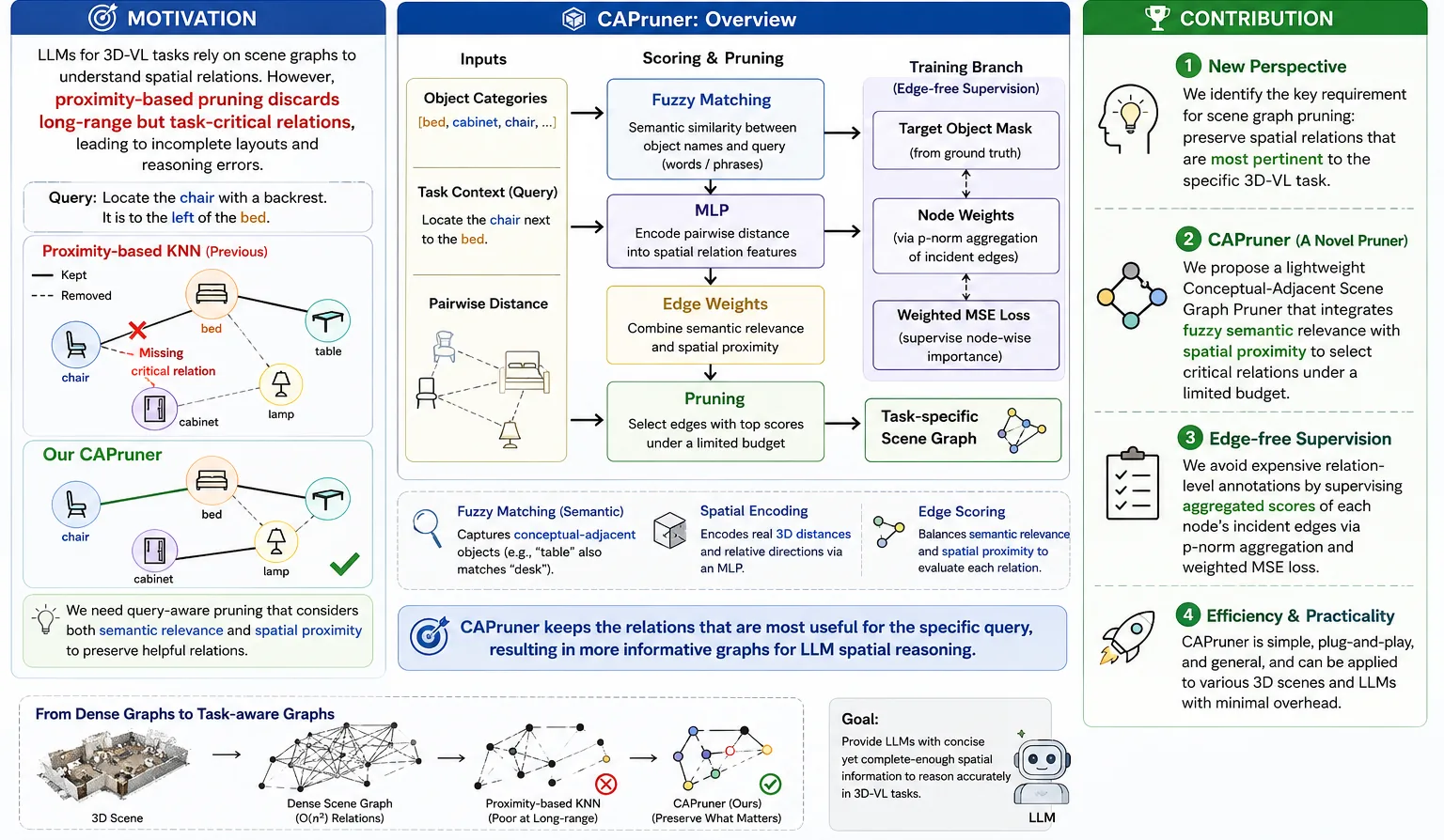
Large language models can use 3D scene graphs for spatial reasoning, but full graphs are expensive and noisy. Proximity-only pruning is efficient, yet it can remove relations that are essential for a particular 3D vision-language task.
CAPruner addresses this by selecting task-specific scene-graph relations with both semantic relevance and spatial proximity. The goal is to keep a compact relation set that still preserves the key spatial evidence needed for grounding and question answering.
Key Ideas
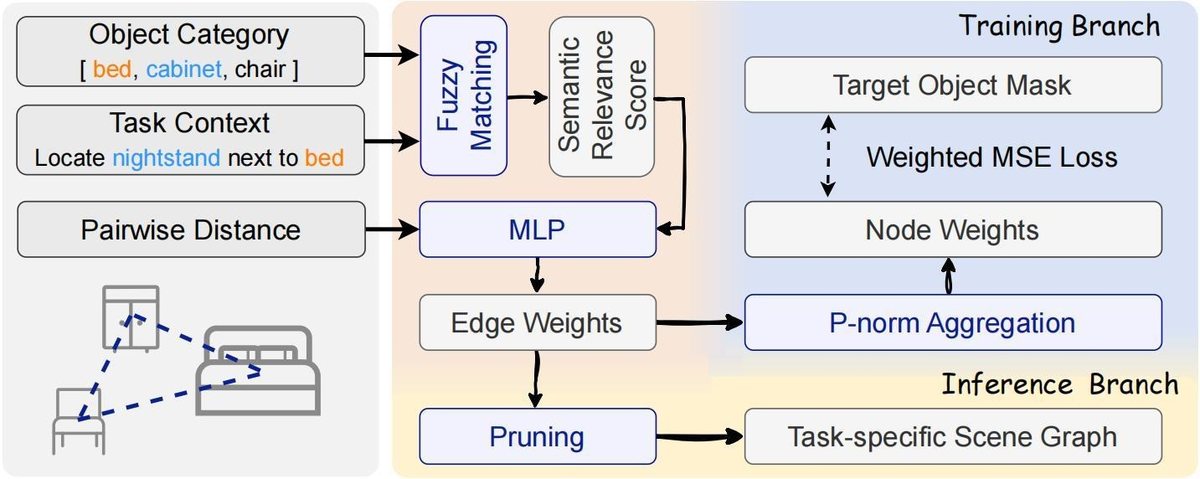
- Fuzzy matching links object categories with the task context.
- Semantic relevance and pairwise distance are combined to score relations.
- Edge scores are aggregated into node-level supervision, avoiding costly relation-level annotations.
- The inference branch produces a compact task-specific scene graph for downstream LLM reasoning.
Results
CAPruner improves LLM performance on 3D vision-language tasks while reducing unnecessary graph reasoning overhead. The method is designed to keep task-critical relations instead of relying only on nearest-neighbor proximity.
Resources
BibTeX
@misc{zhou2026capruner,
  title={CAPruner: Conceptual-Adjacent Scene Graph Pruner for Enhancing 3D Spatial Reasoning of Large Language Models},
  author={Shengli Zhou and Xiangchen Wang and Guanhua Chen and Feng Zheng},
  year={2026},
  url={https://www.researchgate.net/publication/404391563_CAPruner_Conceptual-Adjacent_Scene_Graph_Pruner_for_Enhancing_3D_Spatial_Reasoning_of_Large_Language_Models}
}